

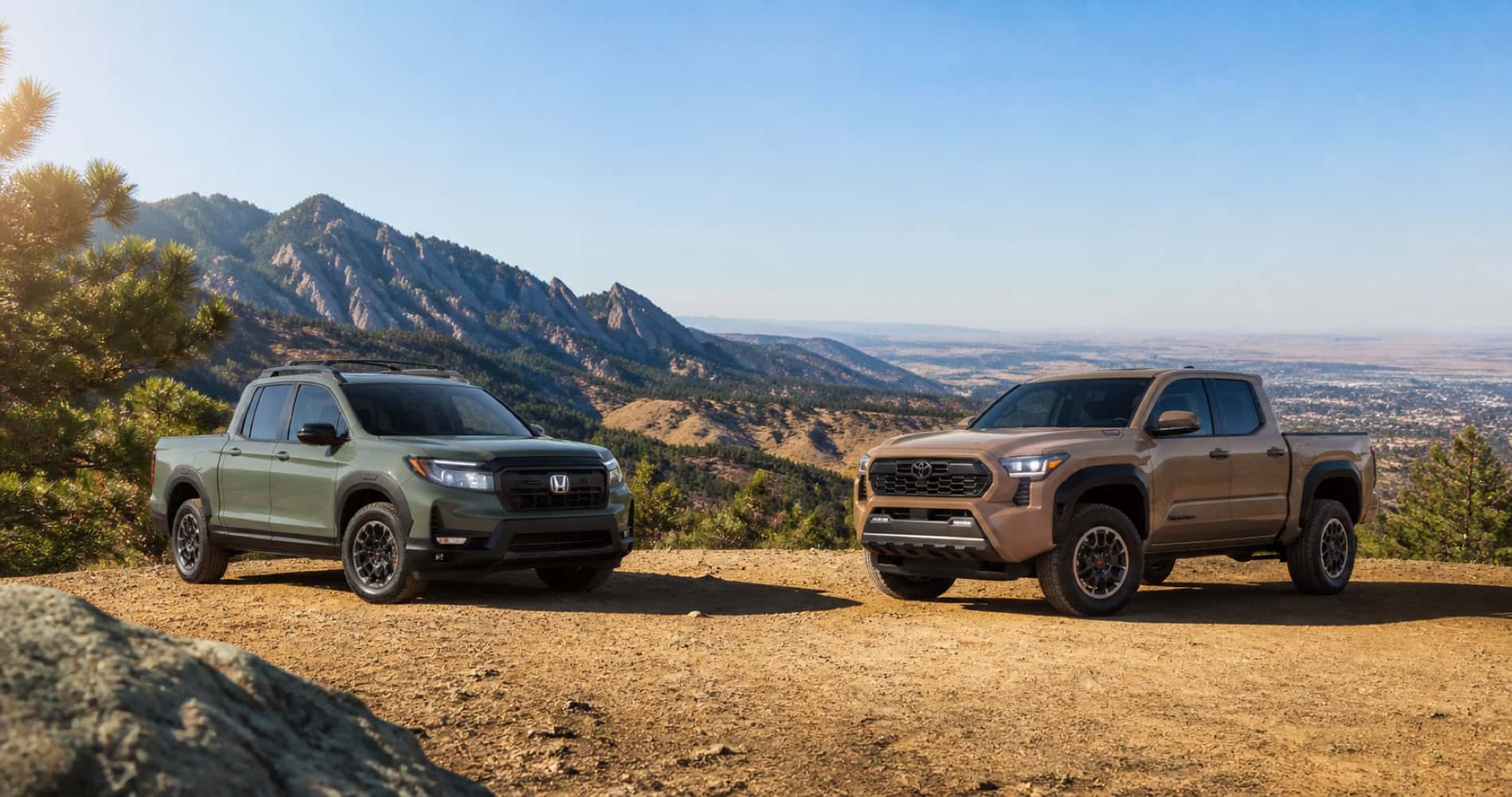
Green Honda Ridgeline and tan Toyota Tacoma parked on dirt overlook with mountain backdrop under clear blue sky showcasing front grille designs and off road capability.

2026 Midsize Truck Comparison

2026 Honda Ridgeline vs Toyota Tacoma

Which Midsize Pickup Fits Your Routine Better?

Everyday Comfort & Clever Utility or Higher Towing & Off-Road Capability?
Choose the Truck That Fits the Jobs You Do Most.


The 2026 Honda Ridgeline and 2026 Toyota Tacoma are natural midsize-truck alternatives, but they take notably different approaches to the job. The Ridgeline concentrates on one five-seat AWD crew-cab formula, while the Tacoma stretches across a much broader range of work, daily-use, and trail-focused configurations.

That makes this less a contest over which truck can post the biggest number and more a question of which compromises you would actually notice. Some Tacoma advantages become decisive when a specific truck job demands them; some Ridgeline advantages matter because they shape nearly every ordinary drive. The useful comparison is the one that keeps those differences in proportion instead of treating every spec-sheet win as equally important.

Around Boulder County, a midsize pickup can move from a US 36 commute to home projects, winter-weather travel, outdoor gear, and weekend towing without changing roles. The sections below separate the everyday differences from the capability limits so you can see where the Ridgeline or Tacoma better matches the work your truck will repeat.


Which Midsize Truck Fits the Work You Actually Ask It to Do?

Choose the priority that repeats most often in your week. This gives you a directional starting point; the detailed comparison below shows where truck architecture, towing, bed utility, cabin comfort, and off-road equipment can change the answer.


Based on This Priority

Daily Comfort & Easy Truck Utility Matter

Start With the Honda Ridgeline

Who This Favors

Drivers who use their truck as a daily vehicle first and still want a crew cab, standard AWD, five seats, and useful open-bed capability.

Why It Points Here

The Ridgeline standardizes the lineup around a unibody crew-cab layout with fully independent suspension, i-VTM4 AWD, a V6, and the same bed-and-trunk utility on every core trim.


Ridgeline vs Tacoma in 60 SecondsSix answers that clarify the midsize-truck decision

Which starts at the lower price?
The Tacoma. Its current 2026 lineup starts at $32,545, while the Ridgeline Sport starts at $40,795. That opening-price gap is not a like-for-like crew-cab AWD comparison: the Ridgeline starts as a five-seat crew cab with standard AWD, while Tacoma pricing spans different cab and drivetrain arrangements.


Which can tow and carry more at the maximum?
The Tacoma. Its maximum towing rating is 6,500 pounds versus 5,000 for every Ridgeline, a meaningful 1,500-pound difference. Maximum payload is much closer: 1,705 pounds for Tacoma versus 1,583 pounds for Ridgeline, only 122 pounds apart at the published ceilings.


Which is built more around everyday ride comfort?
The Ridgeline. Its unit-body construction and fully independent suspension are central to its road-focused character, while the Tacoma uses Toyota's TNGA-F truck chassis and offers suspension tuning that ranges from work-oriented to specialized off-road setups.


Which has the more flexible bed-storage setup?
The Ridgeline has the more unusual built-in storage solution: a 64-inch bed with a lay-flat floor, dual-action tailgate, and 7.3-cubic-foot lockable In-Bed Trunk. Tacoma counters with the ability to choose 5- or 6-foot SMC beds and, on hybrid models, a standard 2400W AC power supply.


Which has the broader off-road lineup?
The Tacoma. TRD Off-Road, TRD Pro, and Trailhunter offer a substantially deeper range of suspension, traction, underbody, and recovery hardware. Ridgeline TrailSport takes a lighter-duty approach that adds all-terrain tires, a skid plate, and off-road-tuned suspension without changing the truck's basic daily-use character.


Which gives you more configuration choice?
The Tacoma. It offers two cab styles, two bed lengths, gas and hybrid powertrains, 2WD and 4WD routes, and an available manual transmission. Ridgeline buyers choose equipment and trim around one core five-seat AWD crew-cab layout.

The Difference Underneath the Truck

Why Does Unibody vs Truck-Frame Architecture Matter Here?

This is the foundational split behind several later tradeoffs. The Ridgeline integrates the body and structure and pairs that with four-wheel independent suspension. Tacoma uses Toyota's TNGA-F truck platform, then changes suspension, drivetrain, cab, bed, and off-road hardware across a much wider configuration range.

Honda Ridgeline

One Integrated Daily-Driver Formula

On the road: Unit-body construction and independent front and rear suspension prioritize composed everyday manners.

For truck work: Standard AWD and one fixed crew-cab/bed package keep the truck's everyday utility consistent across the lineup.

Tradeoff: You do not get Tacoma's cab, bed, drivetrain, hybrid, manual-transmission, or extreme off-road range.

Toyota Tacoma

A Truck Platform With More Specialized Branches

On the road: The current TNGA-F chassis and available coil-spring multi-link rear suspension improve refinement compared with older truck formulas.

For truck work: Multiple cab, bed, drivetrain, powertrain, and suspension combinations let buyers configure more specifically around work or trail priorities.

Tradeoff: The wider lineup asks you to choose the right configuration rather than giving every Tacoma the same daily-use package.

The Architecture Matters Because It Changes the Questions You Should Ask

If the truck is primarily a daily vehicle that also handles ordinary pickup work, the Ridgeline's standardized formula can be an advantage because its basic character changes very little by trim. If the job requires a specific cab, longer bed, powertrain, drivetrain, or specialized trail setup, Tacoma's wider branching structure becomes the more important strength. The detailed panels below handle the actual powertrain, load, towing, and equipment differences.
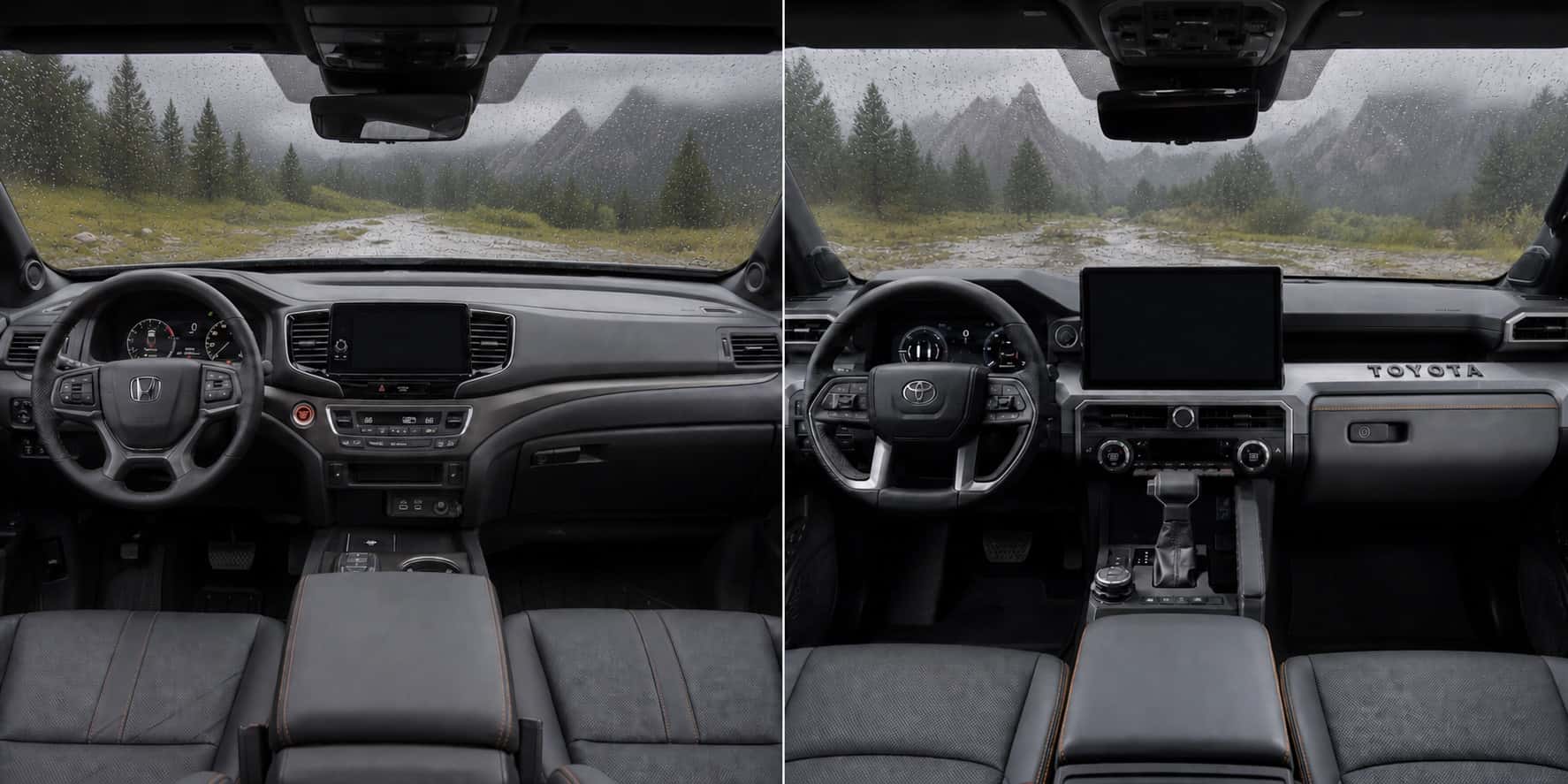

Side by side view of Honda Ridgeline and Toyota Tacoma cabins showing dashboard layouts touchscreen displays and steering wheel designs with rain outside.

Where Do the Ridgeline & Tacoma Separate Most Clearly?

Start with the truck formula itself, then move through bed and cabin utility, towing and trail capability, everyday technology, and the price required to get the configuration you actually want.

Start With the Big Decision; Then Compare by Priority


Start Here

Which Differences Are Big Enough to Change the Shortlist?

The two trucks overlap in midsize dimensions and five-seat potential, but their product strategies are unusually different. Start with the architecture and configuration choices, because they explain why the same buyer can reasonably prefer one truck for everyday life and the other for heavier work or deeper trail use.

2026 Honda Ridgeline vs 2026 Toyota Tacoma at a Glance
Category 2026 Honda Ridgeline 2026 Toyota Tacoma
Starting MSRP* $40,795
Sport; crew cab & AWD standard
$32,545
SR lineup entry; cab/drivetrain configurations vary
Core Architecture Unit-body construction
Rear suspension: independent multi-link
TNGA-F truck platform
Rear suspension: leaf-spring or coil-spring multi-link depending configuration
Powertrain Strategy 3.5L V6: 280 hp / 262 lb-ft
Transmission: 9-speed automatic
i-FORCE: up to 278 hp / 317 lb-ft
i-FORCE MAX hybrid: up to 326 hp / 465 lb-ft
Transmission: 8-speed automatic or available 6-speed manual
Drivetrain Structure i-VTM4 AWD: standard on every Ridgeline 2WD, part-time 4WD & full-time 4WD: availability depends on configuration
Cab & Bed Choice Five-seat crew cab
Bed: 64 in with tailgate up
XtraCab or Double Cab
Beds: 5 ft or 6 ft
Maximum Towing* 5,000 lb 6,500 lb
Maximum Payload* Up to 1,583 lb Up to 1,705 lb
Standout Utility Dual-action tailgate
7.3-cu-ft lockable In-Bed Trunk
Lay-flat bed floor
5- or 6-ft SMC bed
Hybrid: standard 2400W AC power supply
Available: advanced towing & trail technology
Starting MSRP values are current manufacturer base prices and exclude destination and handling, taxes, title, license, options, accessories, and dealer charges. The two lineup entry points are not configuration-equivalent because Ridgeline starts as a five-seat AWD crew cab while Tacoma begins with a broader set of cab and drivetrain choices. Towing and payload depend on configuration, equipment, passengers, cargo, hitch weight, and accessories.

The Biggest Gaps Are Not All the Same Size

Tacoma's $8,250 lower lineup entry and 1,500-pound higher maximum towing rating are substantial differences, even though the entry configurations are not equivalent. Its maximum payload advantage is much smaller at 122 pounds. Ridgeline's case is less about beating those ceilings and more about putting AWD, a five-seat crew cab, V6 power, and its distinctive bed-storage package into every truck. That is the scale to keep in mind as the detailed panels separate the tradeoffs.

Powertrain & Efficiency

How Much Do the Powertrain & Drivetrain Choices Change the Fit?

The Ridgeline keeps one V6, 9-speed automatic, and AWD strategy across the lineup. Tacoma gives buyers several output, transmission, and drivetrain paths, including a higher-torque hybrid route and an available manual transmission on select gas models.

Powertrain, Drivetrain & Efficiency Comparison
Category 2026 Honda Ridgeline 2026 Toyota Tacoma
Gas Powertrain 3.5L V6: 280 hp / 262 lb-ft
Transmission: 9-speed automatic
2.4L turbo i-FORCE: up to 278 hp / 317 lb-ft with the automatic
Manual route: 270 hp / 310 lb-ft where offered
Hybrid Route No hybrid powertrain offered for 2026 i-FORCE MAX: up to 326 hp / 465 lb-ft
Transmission: 8-speed automatic
EPA City / Highway* Sport / RTL / Black Edition: 18 / 24 MPG
TrailSport: 18 / 23 MPG
Gas: published trim ratings reach 21 / 26 MPG
i-FORCE MAX: published trim ratings reach 23 / 24 MPG
Drivetrain Strategy i-VTM4 AWD: standard on every Ridgeline
Drive modes: Normal, Snow, Sand & Mud
2WD / part-time 4WD / full-time 4WD: availability depends on configuration
full-time 4WD is used on Limited i-FORCE MAX
EPA estimates are for comparison only; actual mileage varies with traffic, temperature, speed, loading, maintenance, fuel, accessories, tires, and driving habits. Tacoma MPG varies materially by powertrain, drivetrain, cab, bed, and trim; the table uses the highest published city/highway pairings within its gas and i-FORCE MAX lineups rather than treating every Tacoma configuration as identical.

Ridgeline Keeps the Powertrain Decision Simple; Tacoma Offers More Ways to Tune It

Ridgeline buyers get the same 280-hp V6, 262 lb-ft of torque, 9-speed automatic, and AWD strategy from Sport through Black Edition. Tacoma can trade a lower-output entry configuration for higher gas-engine torque, a manual transmission, or the 465-lb-ft i-FORCE MAX hybrid. Fuel economy overlaps more than the powertrain variety suggests, so the strongest Tacoma reason here is choice and torque breadth rather than a universal MPG advantage.

Cabin & Bed Utility

Which Truck Makes Everyday Cargo Easier to Organize?

Both trucks can carry the normal mix of people and gear, but they approach packaging differently. Ridgeline keeps one passenger-and-bed layout and adds unusual storage solutions. Tacoma lets the buyer trade rear seating, bed length, and power features against each other by configuration.

Cabin Flexibility & Bed Utility Comparison
Category 2026 Honda Ridgeline 2026 Toyota Tacoma
Cab & Seating Five seats
Body: four-door crew cab
Double Cab: rear seating for passengers
XtraCab: two-seat utility layout with lockable rear storage
Rear-Seat Space & Flexibility Rear legroom: 36.7 in
Seat: 60/40 split lift-up
Underseat storage: 2.9 cu ft
Double Cab rear legroom: 33.7 in
Double Cab: flip/fold rear seating & storage
XtraCab: no rear passenger seat; lockable storage
Bed Dimensions Length: 64.0 in
Width between wheel wells: 50.0 in
Floor: lay-flat design
Length: 60.3 or 73.5 in
Width between wheel wells: 44.7 in
Bed: aluminum-reinforced SMC
Secure Storage Lockable In-Bed Trunk: 7.3 cu ft
Drain plug: included
Cab-dependent lockable storage
XtraCab: lockable rear compartments
Cargo Access Dual-action tailgate: folds down or swings to the side Conventional tailgate
Available utility: onboard air compressor, scene lighting & power features by configuration
Bed Power Black Edition: 150W / 400W truck-bed power outlet i-FORCE MAX hybrid: standard 2400W AC power to the cabin & bed
Bed and cabin features vary by trim and configuration. The Tacoma offers more body and bed combinations; the Ridgeline keeps one standardized crew-cab and bed package, so its bed-storage features are easier to compare across the lineup.

Ridgeline Emphasizes Width & Built-In Storage; Tacoma Adds the Longer-Bed Route

The Ridgeline bed is 5.3 inches wider between the wheel wells, which matters for broad cargo, and its lockable In-Bed Trunk plus side-opening tailgate solve secure-storage and access problems without an accessory box. Tacoma counters with a 73.5-inch long-bed option—9.5 inches longer than the Ridgeline bed—plus XtraCab storage and much higher-output hybrid bed power. Neither bed is simply more versatile; they solve different cargo shapes and work patterns.

Towing & Trail Capability

Where Do Heavier Truck Jobs Change the Answer?

This is where Tacoma creates its clearest functional advantage, but the gaps are not equal. Maximum towing is 1,500 pounds higher, while maximum payload is only 122 pounds higher. Tacoma also offers a much deeper set of trailer-assistance and technical trail hardware.

Towing, Payload & Trail Capability Comparison
Category 2026 Honda Ridgeline 2026 Toyota Tacoma
Maximum Towing* 5,000 lb
all 2026 Ridgeline configurations
6,500 lb
maximum in applicable configurations
Maximum Payload* 1,583 lb
Sport; published capacity declines slightly on heavier trims
Up to 1,705 lb
configuration-dependent
Factory Towing Hardware Integrated Class III trailer hitch: standard Tow hitch: standard or available by configuration
Trailer Guidance Technology Rearview camera: dynamic guidelines standard Available: Trailer Backup Guide with Straight Path Assist, integrated trailer brake controller & trailer-aware Blind Spot Monitor
Trail-Oriented Route TrailSport: off-road-tuned suspension, all-terrain tires & skid plate TRD Off-Road: Bilstein hardware and available SDM
TRD Pro / Trailhunter: specialized FOX / Old Man Emu suspension and additional protection
Low-Speed Trail Systems Intelligent Traction Management: Sand & Mud modes included Available: Multi-Terrain Select, CRAWL Control, electronically locking rear differential & Multi-Terrain Monitor
Maximum towing and payload ratings are not additive and depend on the exact configuration. Passenger, cargo, accessory, hitch, tongue, and equipment weight reduce available payload and can reduce allowable trailer weight. Off-road hardware and traction systems do not replace route judgment, appropriate tires, safe speeds, or driver attention.

Tacoma's Bigger Capability Advantages Are Towing & Trail Hardware—not Payload Alone

The payload ceilings are close enough that the exact truck and door-jamb label matter more than the 122-pound headline difference. Towing is different: Tacoma's 6,500-pound maximum creates 1,500 pounds more theoretical trailer margin than the Ridgeline's fixed 5,000-pound rating. Add Tacoma's trailer guidance, low-speed trail systems, and specialized suspension hardware, and it becomes the stronger starting point when those capabilities are recurring requirements rather than occasional possibilities.

Comfort & Technology

Which Cabin Differences Will You Notice Every Day?

Ridgeline puts a useful technology and comfort baseline into every truck, while Tacoma's broader configuration ladder can start simpler and climb to a substantially more elaborate premium and off-road technology ceiling.

Comfort, Technology & Daily-Use Equipment
Category 2026 Honda Ridgeline 2026 Toyota Tacoma
Center Display 9-in color touchscreen: standard across the lineup 8-in touchscreen: standard
14-in touchscreen: available
Driver Display 7-in color meter display: standard 12.3-in digital gauge cluster: available
instrumentation varies by configuration
Smartphone Integration Wireless Apple CarPlay & Android Auto: standard Wireless Apple CarPlay & Android Auto: standard
Charging & Cabin Power Wireless phone charger: standard
USB: front USB-A & USB-C standard; two rear USB-C ports on Black Edition
Qi wireless charging & USB-C: availability varies by configuration
Climate & Seating Tri-zone automatic climate control: standard
Higher trims: heated, leather-trimmed and ventilated-seat availability
Trim-dependent comfort ladder
Limited / upper trims: heated and ventilated SofTex-trimmed front seating plus premium equipment
Driver Assistance Honda Sensing: standard
Also standard: blind-spot information & cross-traffic monitor
Toyota Safety Sense 3.0: standard
Also available/standard: blind-spot monitor & rear cross-traffic alert
Feature availability varies by trim, configuration, compatible device, subscription/trial status, and option package. Driver-assistance, camera, connectivity, and parking systems do not replace attentive driving or direct visual confirmation.

Ridgeline Starts With More Cabin Convenience; Tacoma Offers the Higher Display Ceiling

A Ridgeline Sport starts with a 9-inch touchscreen, wireless smartphone integration, wireless charging, and tri-zone climate control. Tacoma starts with an 8-inch touchscreen but can move to a 14-inch center display and an available 12.3-inch digital gauge cluster. The Honda advantage is the stronger standard convenience baseline; the Toyota advantage is the higher display and specialized-technology ceiling when that equipment is selected.

Price, Configurations & Value

What Are You Paying For & What Ownership Support Comes With It?

Tacoma's $32,545 lineup entry is $8,250 below the Ridgeline Sport, and that is a real affordability advantage for shoppers who do not need the Honda's standard AWD crew-cab package. The configurations are not equivalent, so the table follows the pricing and lineup differences into factory warranty, included maintenance, and a modest current reliability signal.

Pricing, Lineup & Ownership Value Checkpoints
Category 2026 Honda Ridgeline 2026 Toyota Tacoma
Lineup Entry* Sport - $40,795
AWD crew cab
SR - $32,545
lineup base; configuration varies
Lineup Structure 6 listed configurations: Sport, RTL, TrailSport, TrailSport+HPD Wheels, Black Edition & Black Edition Two-Tone 11 listed versions: 6 gas & 5 i-FORCE MAX/electrified entries
cab, bed, drivetrain & transmission availability varies within the lineup
Trail Checkpoint* TrailSport - $45,995
off-road-tuned suspension, all-terrain tires & skid plate
TRD Off-Road - $42,815
base MSRP; drivetrain/options determine final configuration
Hybrid Power Upgrade* No hybrid offered TRD Sport i-FORCE MAX - $47,335
TRD Off-Road i-FORCE MAX - $47,635
Premium Checkpoint* Black Edition - $47,395
Black Edition Two-Tone - $47,895
Limited - $53,570
Limited i-FORCE MAX - $56,895
Lineup Price Ceiling* Ridgeline ceiling: $47,895 in current core/appearance configurations Trailhunter - $63,750
TRD Pro - $64,750
Basic Warranty 3 yr / 36,000 mi 3 yr / 36,000 mi
Powertrain Warranty 5 yr / 60,000 mi 5 yr / 60,000 mi
Included Maintenance Honda Service Pass: 12 months / 12,000 mi
select factory-scheduled maintenance, including oil changes, tire rotations & multi-point inspections
ToyotaCare: 2 yr / 25,000 mi
normal factory-scheduled maintenance
J.D. Power Quality & Reliability* 82/100 - Great
current 2026 model-page score
80/100 - Average
current 2026 model-page score
MSRP excludes destination and handling, taxes, title, license, options, accessories, dealer-installed equipment, and dealer charges. Tacoma base prices represent trim-level entry points and can span multiple cab, bed, drivetrain, transmission, powertrain, package, and option configurations; they should not be treated as equipment-equivalent matches to Ridgeline trims. Warranty and complimentary-maintenance terms are subject to program limitations and whichever time/mileage threshold comes first. J.D. Power scores and qualitative labels are current model-page Quality & Reliability ratings and may change as its evaluations are updated; the linked scores are supporting ownership context rather than a primary decision factor.

The Ownership Story Is More Balanced Than the Sticker Prices Alone

Tacoma remains the less expensive truck to enter and ToyotaCare provides the longer included-maintenance window, while the two trucks share the same 3-year/36,000-mile basic and 5-year/60,000-mile powertrain warranty terms. The current J.D. Power model pages give the Ridgeline only a small Quality & Reliability edge over the Tacoma. That is useful ownership context, but not enough separation to outweigh the larger differences in towing, price, bed configuration, everyday packaging, and off-road hardware. Value still depends on the exact configuration you would actually buy and the ownership benefits you will use.


Independent Review Context

MotorTrend Gives the Ridgeline a Narrow Edge in This Midsize-Truck Matchup

MotorTrend

2026 Honda Ridgeline

8.8/10 Rating
#4 Best Midsize Pickup Trucks

Ride and handling balance, a roomy cabin, and the dual-action tailgate are central to MotorTrend's Ridgeline case.

Review takeaway: MotorTrend highlights the Ridgeline's smooth, carlike driving experience, useful cabin space, and unusually practical bed design. The publication specifically ties that road behavior to the unibody layout and fully independent suspension, while still crediting the V6 and standard AWD for making the truck useful beyond commuting. Its main limitation is the same one this comparison finds in the specs: one cab-and-bed formula and a lower towing ceiling than more traditional midsize trucks.

MotorTrend

2026 Toyota Tacoma

8.5/10 Rating
#5 Best Midsize Pickup Trucks

Strong driving dynamics, useful front-cabin storage, and modern infotainment reinforce Tacoma's broad capability story.

Review takeaway: MotorTrend credits the current Tacoma with much better road manners and technology than the truck it replaced, plus strong low-end torque and a wide range of configurations for work and off-road use. The publication also calls out the useful interior storage and easy-to-use infotainment. Its main daily-use compromise is tighter rear-seat space, which matters most when a Double Cab will regularly carry adults rather than serving primarily as a work or recreation truck.

How to read the ratings:
MotorTrend separates these trucks by only 0.3 points and one ranking position, so the result is useful supporting context rather than a decisive verdict. Its Ridgeline review reinforces the everyday ride, cabin, and bed-utility case; its Tacoma review reinforces the improved road manners, technology, torque, and configuration breadth. The stronger fit still depends on which of those differences you will use.

Ready to Check the Ridgeline in Person?

Load It, Drive It & Check the Everyday Truck Fit

Bring the people and gear you carry most, then check rear-seat access, the lift-up seat, side-opening tailgate, In-Bed Trunk, bed reach, visibility, and how the V6 and AWD truck feel on the roads you drive every week. Current Ridgeline inventory and trade value can anchor that test around a realistic trim and budget.
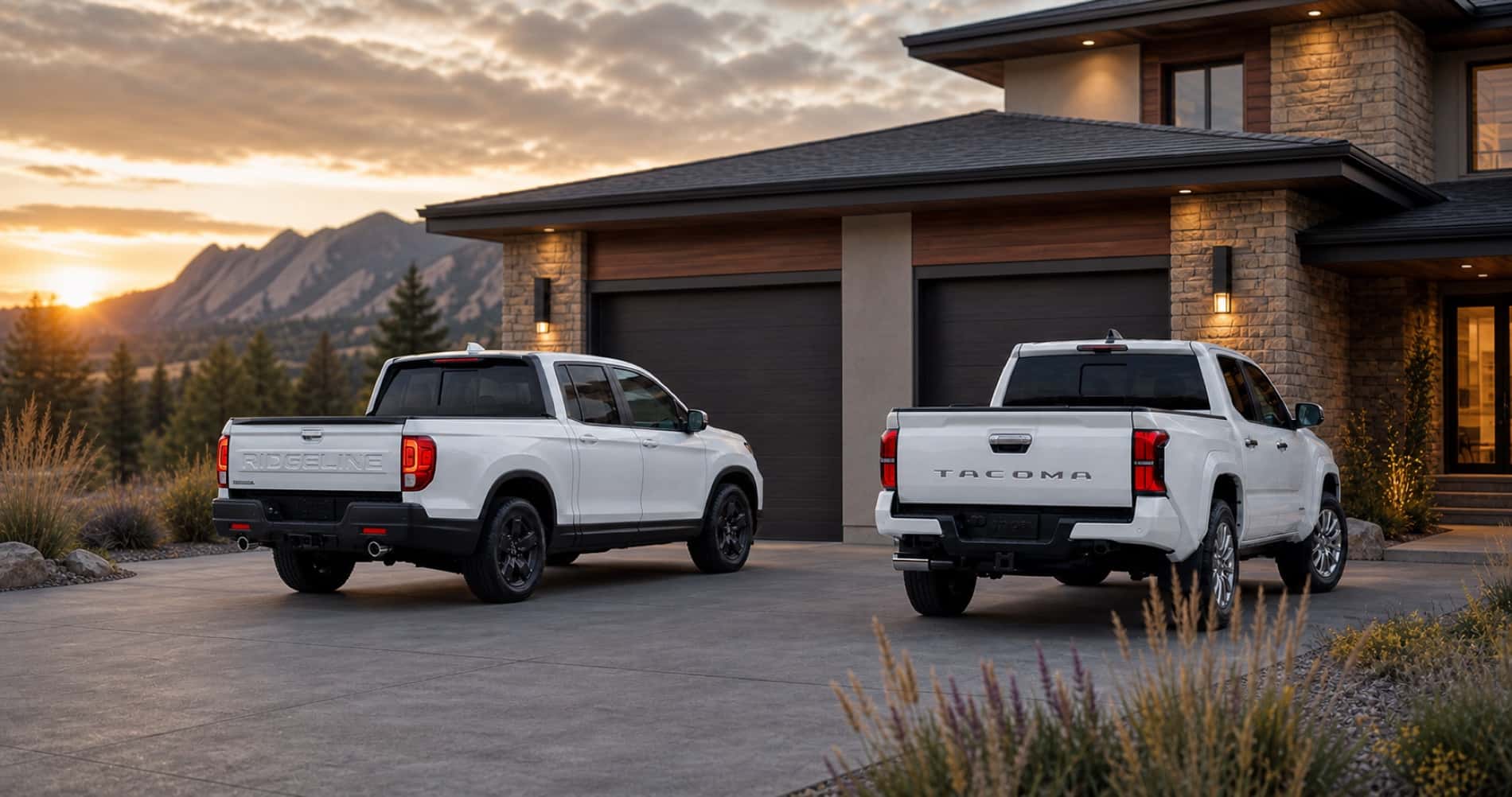
White Honda Ridgeline and white Toyota Tacoma parked side by side in driveway at sunset in front of modern mountain home highlighting rear styling and design differences.

How the Midsize-Truck Tradeoffs Add Up

When Does the Ridgeline Make More Sense
Than the Tacoma?

The Ridgeline makes the stronger case when its limits already clear your real truck jobs with comfortable margin and the vehicle still has to work well as everyday transportation. Its wider bed between the wheel wells, lockable In-Bed Trunk, side-opening tailgate, rear-seat space, and consistent AWD crew-cab formula are advantages you can use without choosing a specialized configuration first.

The Tacoma becomes the stronger answer when a requirement falls outside that envelope: towing beyond 5,000 pounds, a true 6-foot-bed need, hybrid torque, a manual transmission, or technical off-road hardware. Its maximum payload is only 122 pounds above the Ridgeline's, so payload alone is not the same-size advantage as towing or trail capability. The cleanest decision is to identify the first Tacoma-specific capability you would use repeatedly; if there is not one, the Ridgeline's everyday packaging becomes much easier to justify.

Still Split Between Ridgeline Everyday Ease & Tacoma Capability Breadth?
Use the Quiz to Let Your Repeated Truck Jobs Settle It.

4-Question Fit Check

Find Your Better Midsize-Truck Starting Point

Answer four questions about daily use, towing and payload, cabin and bed strategy, and off-road hardware. The result points you toward the truck to investigate first; it does not replace loading, measuring, or driving the exact configuration.

Use these four questions as a decision checklist:

  1. Would everyday ride comfort and the In-Bed Trunk matter more often than maximum towing?
  2. Does your real trailer exceed 5,000 pounds, or does your exact load calculation require more payload than the Ridgeline configuration you are considering?
  3. Do you need a 6-foot bed, XtraCab, hybrid bed power, or another Tacoma-specific configuration?
  4. Will you actually use Tacoma's deeper locking-differential, CRAWL, SDM, TRD Pro, or Trailhunter hardware?

Even without JavaScript, those questions can still guide the comparison.

Question 10 answered

Decision question


Honda Ridgeline vs Toyota Tacoma FAQs

Which costs less, the 2026 Honda Ridgeline or Toyota Tacoma?

The Tacoma has the lower lineup entry at $32,545, which is $8,250 below the $40,795 Ridgeline Sport. The cheapest configurations are not equivalent: Ridgeline starts as a five-seat AWD crew cab, while Tacoma's entry price can represent a two-seat XtraCab and different drivetrain arrangements. The lower Tacoma price is still a real advantage when those Ridgeline-standard features are not priorities.

Which can tow more, the 2026 Ridgeline or Tacoma?

The Tacoma has the higher maximum towing rating at up to 6,500 pounds in applicable configurations, 1,500 pounds above the Ridgeline's 5,000-pound rating. The maximum payload gap is much smaller at 1,705 versus 1,583 pounds. Actual towing and payload limits depend on the exact truck, equipment, passengers, cargo, accessories, hitch setup, and tongue weight.

Does the 2026 Ridgeline offer a hybrid or manual transmission?

No. Every 2026 Ridgeline uses a 3.5-liter V6, 9-speed automatic, and AWD. Tacoma offers gas i-FORCE and i-FORCE MAX hybrid powertrains, and selected gas configurations can still be ordered with a 6-speed manual transmission.

Which has more rear-seat room, the Ridgeline or Tacoma Double Cab?

The Ridgeline has 36.7 inches of rear legroom versus 33.7 inches in the Tacoma Double Cab, a 3.0-inch advantage. Tacoma XtraCab models take a different approach entirely: they remove the rear passenger seat in favor of utility-focused lockable storage.

Is Ridgeline AWD the same as Tacoma 4WD?

No. Every Ridgeline uses Honda i-VTM4 all-wheel drive, which automatically manages torque distribution and includes Normal, Snow, Sand, and Mud modes. Tacoma offers 2WD, part-time 4WD, and full-time 4WD depending on configuration, with low-range and trail-oriented systems available on specific models. The systems are designed around different use cases rather than being interchangeable labels.

Which is better for off-road driving, the Ridgeline or Tacoma?

The Tacoma has the deeper off-road hardware range. TRD Off-Road, TRD Pro, and Trailhunter can add systems such as CRAWL Control, Multi-Terrain Select, an electronically locking rear differential, Stabilizer Disconnect Mechanism, specialized suspension, and additional protection or recovery hardware. Ridgeline TrailSport is the lighter-duty route, adding all-terrain tires, a skid plate, and off-road-tuned suspension while retaining the Ridgeline's everyday-oriented chassis.

Which midsize truck is the better fit for Boulder-area driving?

Ridgeline is the stronger starting point when the truck spends substantial time commuting, carrying passengers, and supporting ordinary home or recreation use while its 5,000-pound towing limit already covers the trailer. Tacoma becomes more compelling when a longer bed, higher towing ceiling, hybrid or manual powertrain, or deeper off-road system will be used often enough to outweigh the Ridgeline's everyday packaging advantages.


Shopping & Ownership Support

Why Fisher Honda Makes the Ridgeline Easier to Shop & Own

Fisher Honda has been family-owned in Boulder since 1968, and its upfront-pricing approach is designed to give shoppers the full vehicle price without requiring negotiation. For a Ridgeline buyer deciding among Sport, RTL, TrailSport, and Black Edition configurations, that makes it easier to judge whether a trim or equipment step is worth the added cost without trying to solve the vehicle choice and the negotiation at the same time.

The purchase can also move well beyond browsing before a trip to Arapahoe Road. Fisher Honda's Online Concierge creates personalized payment options and can support completing the purchase process online, while trade-value, financing, and payment tools help establish the budget in advance. That can leave an in-person Ridgeline visit focused on what a screen cannot settle: rear-seat space, bed reach, In-Bed Trunk access, visibility, and whether the truck's ride and packaging fit the people and gear you actually carry.

After delivery, Fisher Honda's Honda factory-trained and ASE-certified specialists support maintenance and repair with Honda-specific tools and Genuine Honda Parts. Online service scheduling can make routine care easier to plan, and loaner vehicles are available to discuss with a service advisor when transportation away from the dealership is needed. That gives Ridgeline owners one familiar place to return for service questions long after the comparison and purchase are finished.

Where to Go Next

Start Shopping or Keep Researching

Ready to Shop?

Compare current Ridgeline inventory, schedule a drive, and work through trade value, financing, payments, or current Honda specials around the exact trim you would consider.

Keep Researching

Use Fisher Honda's research hub and Ridgeline-specific guides to narrow trims, towing needs, maintenance planning, and fuel-economy expectations before you shop.


Disclaimers:
*Vehicle specifications, pricing, features, fuel-economy estimates, towing capability, payload, warranty terms, and availability are current as of September 2026 and may change.
*Starting MSRP excludes destination and handling, taxes, title, license, options, accessories, dealer-installed equipment, and dealer charges. Ridgeline and Tacoma lineup entry prices are not configuration-equivalent; Ridgeline starts as an AWD five-seat crew cab while Tacoma pricing spans multiple cab, bed, drivetrain, transmission, and powertrain configurations.
*EPA and manufacturer-estimated mileage figures are for comparison purposes; actual mileage varies with traffic, temperature, speed, loading, maintenance, fuel, accessories, tires, and driving habits.
*Maximum towing and payload require the applicable configuration and equipment. Passenger, cargo, accessory, hitch, and tongue weight reduce available payload and can reduce allowable trailer weight. Confirm the door-jamb payload label and owner's information for the specific truck before towing or loading.
*MotorTrend ratings, class rankings, and review observations belong to the cited publication and may change as its evaluations are updated. J.D. Power Quality & Reliability scores and qualitative labels belong to J.D. Power and may also change as its ratings are updated.
*Driver-assistance, AWD, 4WD, traction, towing, camera, and off-road technologies do not replace attentive driving, appropriate tires, safe speeds, route judgment, or direct visual confirmation. Confirm exact equipment, pricing, and availability on the specific vehicle before purchase.

Menu

Get Directions

6025 Arapahoe Road, Boulder, CO, 80303
Fisher Honda 40.016276, -105.211626.