More Family Space, V6 Versatility & TrailSport Capability or Standard AWD & Hybrid Efficiency? The Better Fit Depends on What Your Week Asks For.
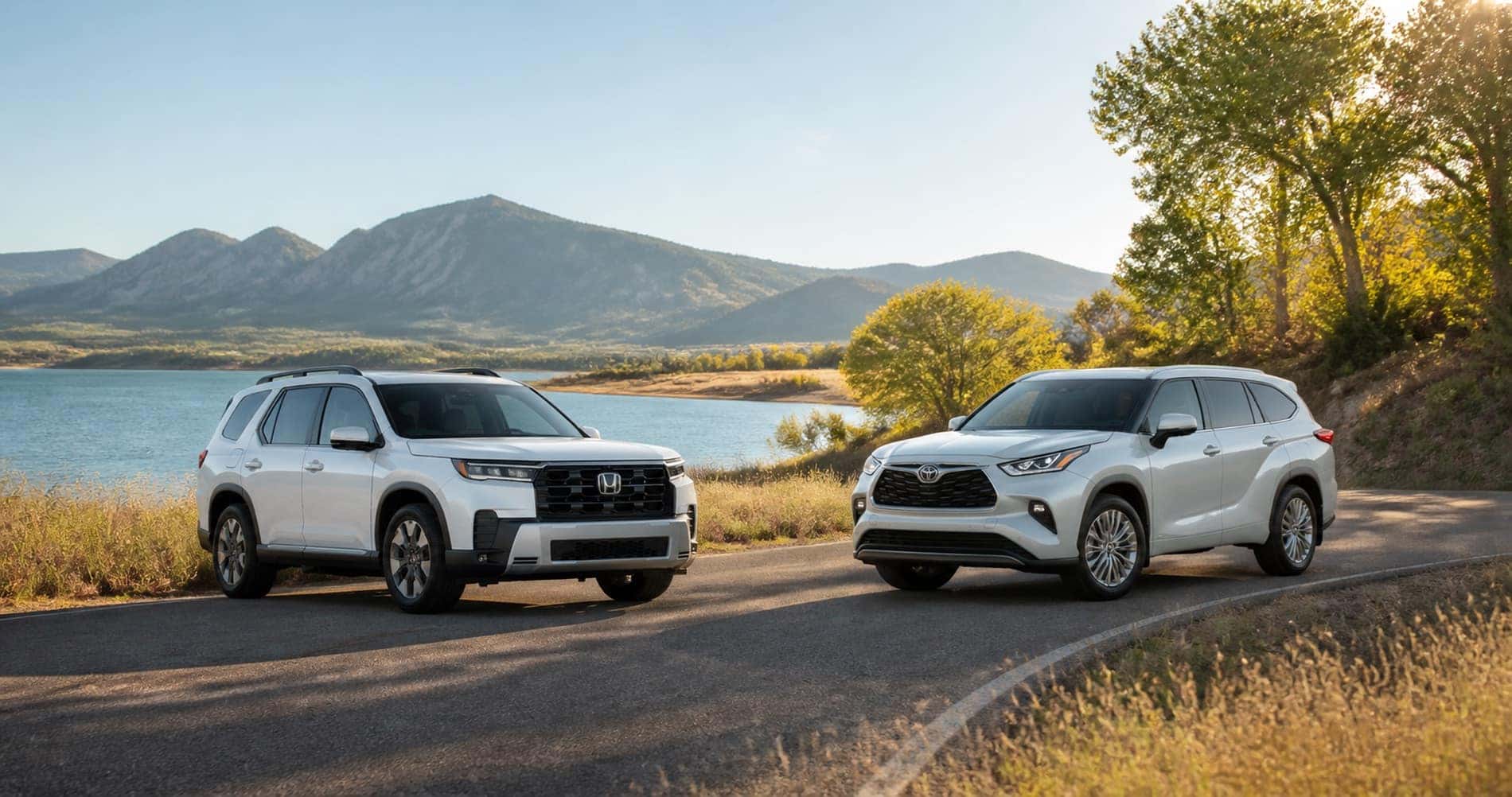
The 2026 Honda Pilot and 2026 Toyota Highlander are natural alternatives for families who want three rows without moving into a full-size SUV. They cover the same broad family-SUV job, but they package people, cargo, powertrains, and all-wheel drive differently enough that the easier vehicle to live with can change with the way your household actually uses all three rows.
The Pilot emphasizes usable three-row room, flexible second-row packaging, and a lineup that stretches from lower-cost front-wheel-drive configurations to the more specialized TrailSport. The Highlander is smaller outside, makes AWD standard for 2026, and keeps an available hybrid as its clearest efficiency advantage. Neither approach is universally better; the useful question is which advantages show up often enough in your real week to matter.
Around Boulder County, that can mean a US 36 commute during the week, carpools and airport runs, then Front Range weekend travel with people and gear aboard. This comparison focuses on the differences that can actually change ownership—space with all rows occupied, fuel use, AWD and capability, cabin equipment, and price—so you can separate meaningful tradeoffs from feature-list noise.
Which Three-Row SUV Fits the Way Your Household Uses It?
Choose the priority that repeats most often in your routine. This gives you a directional starting point; the detailed comparison below shows where price, powertrain, space, AWD, towing, and equipment can change the answer.
Based on This Priority
Family Space & Third-Row Use Matter
Start With the Honda Pilot
Who This Favors
Households that expect the third row and cargo area to work together regularly, not just on the occasional full-passenger trip.
Why It Points Here
The Pilot gives third-row passengers more legroom and leaves more cargo room behind the occupied third row, while also offering a removable or stowable second-row center seat on many eight-passenger trims.
Pilot vs Highlander in 60 SecondsSix answers that clarify the three-row SUV decision▼
Which starts at the lower price? The Pilot. The 2026 Pilot Sport starts at $42,395 with front-wheel drive, while the 2026 Highlander XLE starts at $46,270 with AWD standard. On an AWD-to-AWD basis, a Pilot Sport AWD starts at $44,495, still $1,775 below the Highlander XLE before destination and options.
Which offers a hybrid? The Highlander. Its AWD hybrid lineup starts with the Hybrid XLE and is rated at 35 MPG combined. The Pilot uses a 285-horsepower V6 and does not offer a hybrid powertrain for 2026.
Which has more room when all three rows are in use? The Pilot. It provides 32.5 inches of third-row legroom and 18.6 cubic feet of standard cargo space behind the third row, versus about 28 inches of third-row legroom and 16.0 cubic feet behind the third row in the Highlander.
How do the gas powertrains differ? The Pilot uses a 285-hp 3.5-liter V6 with a 10-speed automatic. The gas Highlander uses a 265-hp 2.4-liter turbo four-cylinder with an 8-speed automatic and produces more peak torque at 310 lb-ft versus 262 lb-ft in the Pilot.
Which can tow more? Neither has a blanket advantage. AWD Pilot models and gas Highlanders are rated up to 5,000 pounds when properly equipped. FWD Pilot models and Highlander hybrids are rated up to 3,500 pounds.
Which has AWD standard? The Highlander. Every 2026 Highlander is AWD. The Pilot lets Sport and EX-L buyers choose FWD or AWD, then makes i-VTM4 AWD standard on TrailSport and higher trims.
Where Do the Pilot & Highlander Separate Most Clearly?
Start with the family-SUV fundamentals, then move into the decisions that can change the better fit: V6 versus hybrid strategy, third-row and cargo packaging, cabin technology, AWD and towing, and the price required to get each configuration.
Start With the Big Decision; Then Compare by Priority
Start Here
Which Differences Are Big Enough to Change the Shortlist?
The Pilot and Highlander overlap in mission, seating count, AWD capability, and gas-model towing. The meaningful split is more specific: the Pilot gives the third row more room and keeps the comparable AWD starting price modestly lower, while the Highlander is smaller outside, makes AWD universal, and uses less fuel in gas form before widening that advantage substantially with its hybrid.
2026 Honda Pilot vs 2026 Toyota Highlander at a Glance
Gas: 2.4L turbo four-cylinder, 265 hp / 310 lb-ft Hybrid: 2.5L hybrid, 243 net hp
EPA / Estimated Combined MPG*
FWD: 22 MPG AWD: 21 MPG TrailSport: 20 MPG
Gas AWD: 24 MPG Hybrid AWD: 35 MPG
Third-Row Legroom
32.5 in
About 28.0 in
Cargo Behind Third Row*
18.6 cu ft standard measurement
16.0 cu ft
Maximum Towing*
AWD: up to 5,000 lb FWD: up to 3,500 lb
Gas AWD: up to 5,000 lb Hybrid AWD: up to 3,500 lb
Drivetrain Structure
FWD or AWD: Sport & EX-L AWD standard: TrailSport & above
AWD standard across the 2026 lineup
Starting MSRP excludes destination and handling, taxes, title, license, options, accessories, dealer-installed equipment, and dealer charges. Pilot Sport AWD pricing is the current published configuration MSRP. Fuel-economy figures vary by configuration and actual driving. Cargo and towing figures require the applicable measurement/equipment conditions.
This Is a Space & Powertrain Choice More Than a Feature-Count Contest
The Pilot makes the stronger case when the third row and cargo area will be used together, when you prefer its V6 and 10-speed automatic, or when TrailSport hardware fits your plans. The Highlander is not only the hybrid alternative: its gas model also uses less fuel than an AWD Pilot, every trim includes AWD, and the hybrid widens the efficiency gap substantially. The better starting point depends on which of those differences repeats most often in your routine.
Powertrain & Efficiency
How Much Should Fuel Use Shape the Powertrain Decision?
The Pilot commits to one engine and transmission across the lineup. The Highlander gives shoppers two distinct AWD powertrain paths: a torquier turbo gas engine or a hybrid that trades output for a substantial efficiency gain.
2.5L four-cylinder hybrid system Net output: 243 hp Drivetrain: Electronic On-Demand AWD
EPA / Estimated MPG*
FWD Sport / EX-L: 19 city / 27 hwy / 22 combined AWD most trims: 19 / 25 / 21 TrailSport: 18 / 23 / 20
Gas AWD: 21 city / 28 hwy / 24 combined Hybrid AWD: up to 35 / 35 / 35 MPG
Fuel
Regular unleaded
Regular unleaded
AWD Availability
Sport & EX-L: FWD or i-VTM4 AWD TrailSport & above: i-VTM4 AWD standard
Gas: mechanical AWD or Dynamic Torque Vectoring AWD by trim Hybrid: Electronic On-Demand AWD All 2026 trims: AWD standard
EPA and manufacturer-estimated mileage figures are for comparison purposes; actual mileage varies with traffic, temperature, speed, loading, maintenance, fuel, accessories, and driving habits. Hybrid system output is net system horsepower and is not directly additive from individual motor/engine ratings.
The Hybrid Creates the Clearest Highlander Advantage; the V6 Keeps the Pilot Distinct
For repeated Denver-Boulder corridor driving, the Highlander Hybrid can materially reduce fuel use without giving up AWD. The Pilot counters with a naturally aspirated V6, a 10-speed automatic, and a consistent powertrain character across every trim. The gas Highlander sits between those approaches: more peak torque than the Pilot and better combined fuel economy, but less horsepower.
Seating & Cargo Space
How Much Does Third-Row Space Matter in Regular Use?
Both SUVs can seat up to eight in selected configurations, but the Pilot uses its larger exterior footprint to create more room where three-row families often feel the compromise first. The Highlander is shorter and narrower outside, which can be appealing when parking and maneuverability matter more than maximum rear-cabin space.
Exterior Size, Seating & Cargo Comparison
Category
2026 Honda Pilot
2026 Toyota Highlander
Exterior Footprint
Length: 200.1 in Width: 78.5 in Wheelbase: 113.8 in
Length: 194.9 in Width: 76.0 in Wheelbase: 112.2 in
Seating Capacity
Up to 8 TrailSport: 7 seats
7 standard Selected XLE / Limited configurations: up to 8 with available bench
Second- / Third-Row Legroom
Second row: 40.8 in Third row: 32.5 in
Second row: 38.7 in Third row: about 28.0 in
Cargo Behind Third Row*
18.6 cu ft standard cargo measurement
16.0 cu ft
Cargo Behind Second Row*
48.5 cu ft standard cargo measurement
48.4 cu ft
Cargo Behind First Row*
87.0 cu ft standard cargo measurement on most trims
84.3 cu ft
Second-Row Flexibility
EX-L, Touring, Touring Blackout, Elite & Black Edition: removable / stowable center seat creates bench-or-captain-chair flexibility
XLE and selected Limited configurations: available second-row bench; captain chairs are the standard seven-seat layout
Honda publishes both standard and maximum cargo figures because its underfloor storage treatment changes the measurement. The table uses the Pilot standard figures for a closer conventional comparison with Highlander cargo measurements. Exact cargo usefulness also depends on seat position, trim, floor configuration, and the shape of the items being carried.
The Pilot Pays Back Its Larger Footprint When All Three Rows Are Busy
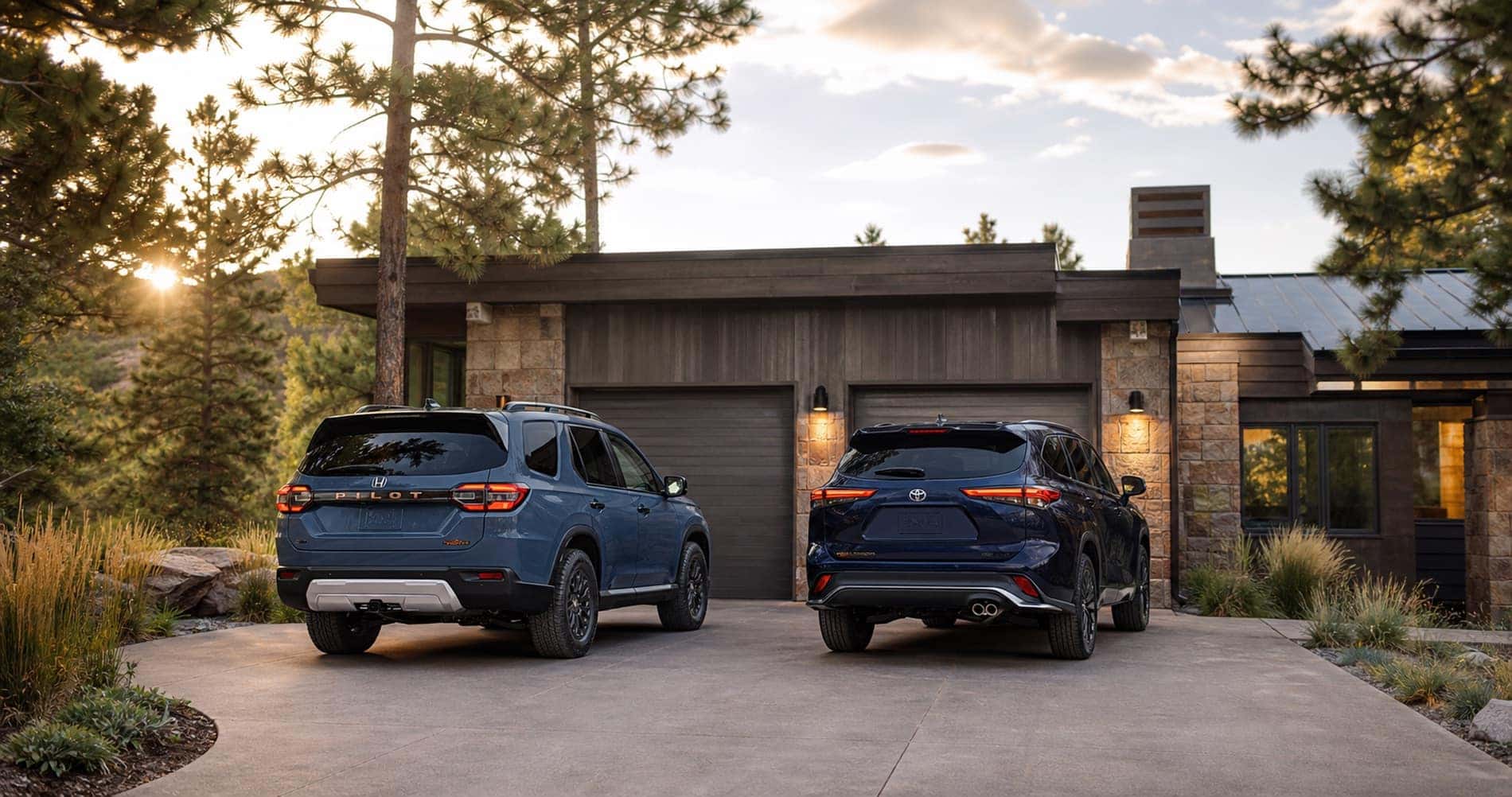
The cargo difference behind the second row is nearly nonexistent, so this is not a blanket cargo victory. The Pilot advantage appears when the third row stays upright: more third-row legroom and more cargo behind it make full-passenger trips easier to package. The Highlander remains the easier-sized vehicle to place in tighter daily spaces because it is roughly five inches shorter and 2.5 inches narrower.
Comfort & Technology
Which Cabin Differences Will You Notice on Every Drive?
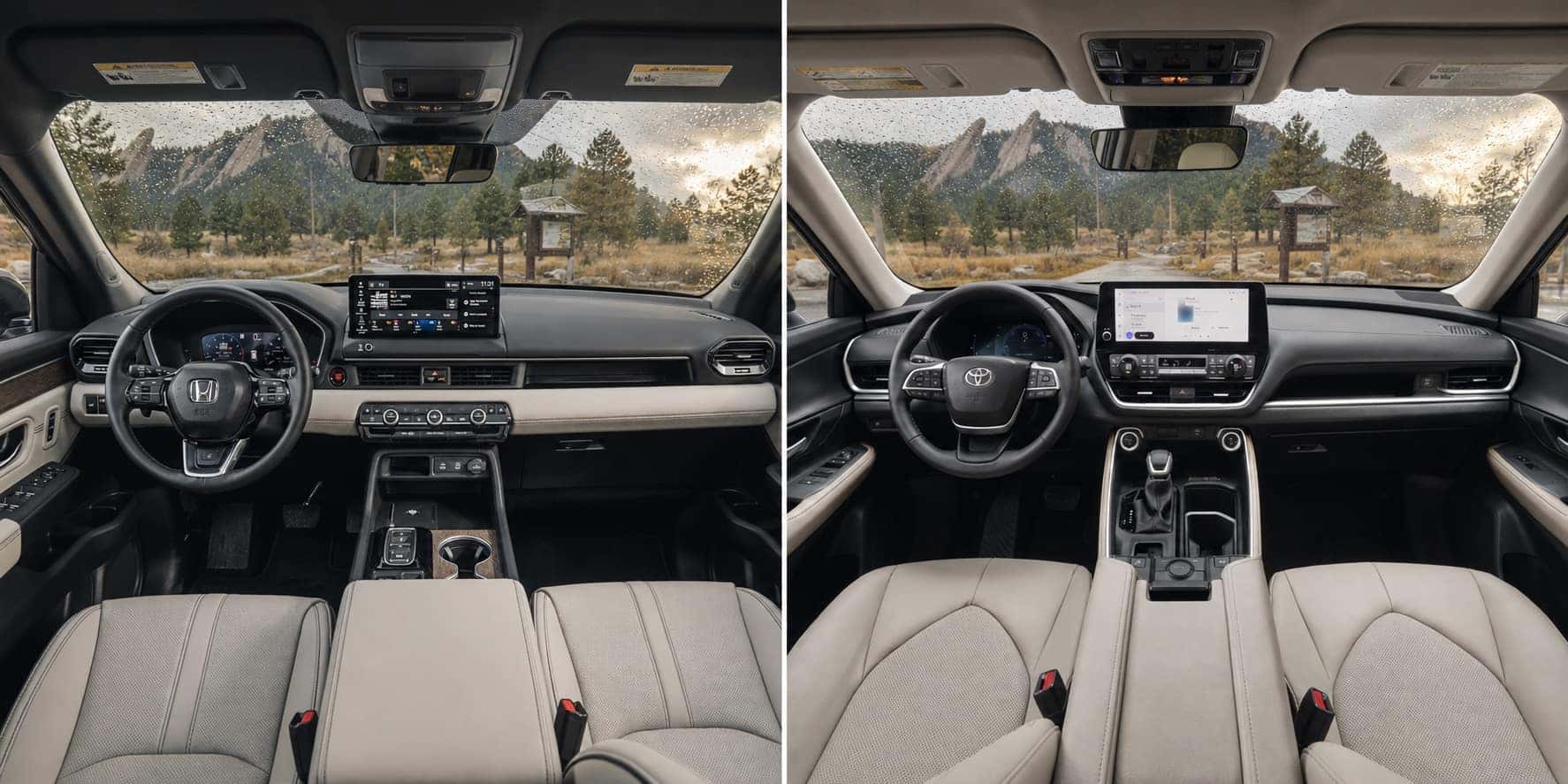
The 2026 Pilot raises its technology baseline with a large touchscreen, digital cluster, wireless smartphone integration, and Google built-in from the entry trim. The Highlander starts from a smaller screen but includes several convenience features early and gives upper trims a strong premium-tech ceiling.
Cabin Technology, Comfort & Family Convenience
Category
2026 Honda Pilot
2026 Toyota Highlander
Center Display
12.3-in color touchscreen: standard across the lineup
8-in Toyota Audio Multimedia: standard on XLE / XSE 12.3-in touchscreen: available on XLE / XSE and standard on Limited / Platinum
Feature availability varies by trim, configuration, compatible device, connected-service subscription, and trial status. Driver information and connectivity systems do not replace attentive driving.
The Pilot Starts With More Screen; the Highlander Builds Up Through Its Trim Ladder
A Pilot Sport buyer gets the larger center and driver displays without stepping up, which makes its lower entry price more meaningful. The Highlander XLE counters with standard wireless charging, a moonroof, heated SofTex seating, and second-row sunshades. At the top of both lineups, the distinction narrows because each can add ventilation, premium audio, head-up information, and expanded camera technology.
AWD, Towing & Capability
Where Does Colorado Use Change the Better Fit?
All-wheel drive is a different kind of decision in these two SUVs. Highlander makes it standard everywhere for 2026. Pilot lets lower-trim buyers decide whether they need it, then uses the TrailSport to create a more specialized capability route within the lineup.
AWD, Towing & Everyday Capability Comparison
Category
2026 Honda Pilot
2026 Toyota Highlander
AWD Strategy
i-VTM4 AWD: available on Sport / EX-L and standard from TrailSport upward rear clutch packs can vary torque between the rear wheels
AWD standard: every 2026 Highlander Gas XSE / Limited / Platinum: Dynamic Torque Vectoring AWD Hybrid: Electronic On-Demand AWD
Maximum Towing*
FWD: up to 3,500 lb AWD: up to 5,000 lb
Gas AWD: up to 5,000 lb Hybrid AWD: up to 3,500 lb
Gas models: Multi-Terrain Select XSE: sport-tuned suspension No direct TrailSport-style trim
Drive Modes
Sport / EX-L: Normal, ECON, Sport, Snow & Tow AWD / higher trims: Trail & Sand added where equipped
Gas: Eco, Normal, Sport & Snow Hybrid: Normal, Eco, Sport & EV modes
Maximum towing requires proper equipment and must be reduced for applicable passenger, cargo, hitch, accessory, and equipment weight. AWD and traction systems can improve available traction but do not eliminate the need for appropriate tires, safe speeds, route judgment, or driver attention.
Highlander Sets a Strong AWD Baseline; TrailSport Builds a More Specialized Pilot
Every Highlander starts with AWD and 8.0 inches of ground clearance, giving Toyota a straightforward all-weather baseline and 0.7 inch more clearance than most Pilot trims. The Pilot counter is TrailSport: 8.3 inches of clearance plus rugged-terrain tires, skid plates, a full-size spare, and trail-focused camera and drivetrain software. At the towing ceiling, neither leads—AWD Pilot and gas Highlander both reach 5,000 pounds when properly equipped.
Price, Trims & Value
What Are You Actually Paying More to Get?
The Pilot has the lower starting point and remains less expensive when both entry configurations are normalized to AWD, but the fair AWD-to-AWD gap is modest rather than dramatic. The Highlander asks more at the bottom because AWD is already included, then offers a hybrid efficiency route the Pilot cannot mirror. Warranty coverage and published reliability data add useful ownership context without creating as much separation as the differences in price, space, or fuel use.
Pricing, Lineup, Warranty & Value Checkpoints
Category
2026 Honda Pilot
2026 Toyota Highlander
Entry Point*
Sport FWD - $42,395
XLE AWD - $46,270
Entry AWD Comparison*
Sport AWD - $44,495
XLE AWD - $46,270
Hybrid Entry*
No hybrid offered
Hybrid XLE AWD - $48,020
Capability Step*
TrailSport AWD - $50,595
XSE AWD - $48,340 sport-styled gas route, not a direct off-road-equipment match
Premium Gas Checkpoint*
Elite AWD - $53,695
Platinum AWD - $53,925
Top of Lineup*
Black Edition AWD - $55,195
Hybrid Platinum AWD - $55,675
Lineup Structure
7 trims Drivetrain choice: FWD or AWD at the low end; AWD standard higher up Powertrain: V6 only
7 trims Drivetrain: AWD standard throughout Powertrains: four gas trims & three hybrids
Factory Warranty Coverage*
New Vehicle Limited Warranty: 3 years / 36,000 miles Powertrain Limited Warranty: 5 years / 60,000 miles
Basic Warranty: 3 years / 36,000 miles Powertrain Warranty: 5 years / 60,000 miles Hybrid-related components: 8 years / 100,000 miles Hybrid battery: 10 years / 150,000 miles
Best fit when: lower entry pricing, third-row utility, V6 response, and the TrailSport route matter more than hybrid economy
Best fit when: standard AWD and an available high-efficiency hybrid justify the higher opening price
MSRP excludes destination and handling, taxes, title, license, options, accessories, dealer-installed equipment, and dealer charges. Toyota pricing shown reflects the current live 2026 Highlander model page; manufacturer pricing can change during the model year. The TrailSport and XSE are not equipment-equivalent trims and are shown as distinct capability/style checkpoints rather than direct substitutes. Warranty coverage is subject to manufacturer terms, limitations, exclusions, and time/mileage conditions. J.D. Power Quality & Reliability scores reflect the publication's current owner-based evaluation and may change as its data is updated.
The Pilot Keeps a Modest AWD Price Edge; the Highlander Adds a Hybrid Path
At the entry AWD level, the difference is $1,775—not the larger gap created by comparing Pilot FWD with an AWD-only Highlander. That gives the Pilot a real but not decisive price advantage, especially because its larger displays and V6 are already standard. Basic ownership protection does little to separate them: both provide 3-year/36,000-mile basic coverage and 5-year/60,000-mile powertrain coverage. J.D. Power also places both in its Great Quality & Reliability range, with the Highlander holding a small 84-to-81 score advantage. Toyota adds longer component and battery coverage for Highlander Hybrid models, complementing the hybrid's substantially lower fuel use. Whether the Highlander's higher purchase price produces an overall cost advantage still depends on mileage, fuel prices, and ownership length, so reliability and warranty are useful supporting context rather than reasons by themselves to outweigh the larger differences in space, efficiency, capability, and price.
Independent Review Context
MotorTrend Ranks the Pilot Near the Top of the Mainstream Three-Row SUV Field
MotorTrend
2026 Honda Pilot
9.2/10 Rating #3 Best Mainstream 3-Row SUVs
Spacious, user-friendly, and strong on safety, with a family-first package that MotorTrend ranks near the top of the class.
Review takeaway: MotorTrend praises the Pilot's spacious, user-friendly interior and strong suite of safety features. Its current model review also records a 6.9-second 0-60 mph result for an AWD Pilot and recommends the Touring as a strong balance of technology, comfort, and versatility. The #3 class ranking reinforces the breadth of the package rather than resting the Pilot's case on one headline specification.
Efficient hybrid options, thoughtful packaging, and solid family practicality remain its clearest strengths.
Review takeaway: MotorTrend credits the Highlander for its efficient hybrid powertrains, thoughtful interior packaging, and continued usefulness as a family SUV. Its current review also notes the simpler 2026 AWD strategy and recommends the XLE as a strong balance of value and features. The #11 class ranking trails the Pilot's #3 position, but the Highlander's hybrid efficiency and smaller exterior footprint remain legitimate reasons some households may prefer it.
How to read the ratings: The 1.2-point score gap and #3-versus-#11 class ranking are large enough to matter as independent editorial context: MotorTrend sees the Pilot as the stronger overall mainstream three-row SUV package. That does not erase the Highlander's 35-MPG hybrid route or smaller exterior footprint; it means those Toyota advantages should be recurring priorities in your routine if they are going to outweigh the Pilot's stronger overall standing in this particular publication's evaluation.
Ready to Check the Pilot in Person?
See How the Pilot's Space Works for Your Family
Bring the passengers and gear you carry most and see how the Pilot’s third-row access, cargo space, flexible second row, and V6 power fit your routine. Then compare current inventory and your trade value to narrow the right configuration and budget.
When Does the Pilot Make More Sense Than the Highlander?
The Pilot is the stronger starting point when all three rows are part of normal family life. Its third row has 4.5 more inches of legroom, it leaves 2.6 more cubic feet behind that row using the comparable standard cargo measurement, and many eight-passenger trims let you remove or stow the second-row center seat. The Pilot Sport AWD also starts $1,775 below the Highlander XLE AWD, so the Honda's space advantage does not require paying a higher comparable entry price.
The Highlander becomes more compelling when the third row is mainly occasional, a smaller exterior is easier to live with, or fuel use matters more than maximizing rear-cabin space. Its gas model is rated at 24 MPG combined versus 21 MPG for most AWD Pilots, and the Highlander Hybrid reaches 35 MPG combined with AWD. That is a much larger ownership difference than the modest AWD price gap. The decision ultimately comes down to which recurring need is harder to compromise: Pilot space and capability breadth, or Highlander efficiency and smaller dimensions.
Still Split Between Pilot Space & Highlander Efficiency? Use the Quiz to Let Your Repeated Priorities Settle It.
4-Question Fit Check
Find Your Better Three-Row SUV Starting Point
Answer four questions about fuel use, family space, AWD and capability, and price. The result points you toward the SUV to investigate first; it does not replace loading or driving the exact configuration.
Use these four questions as a decision checklist:
Would hybrid fuel economy matter more often than V6 response?
Will adults or growing passengers use the third row regularly?
Do you prefer AWD standard everywhere or a Pilot lineup with FWD, AWD, and TrailSport choices?
Is the Highlander's hybrid/standard-AWD strategy worth paying more for than an equivalent Pilot starting point?
Even without JavaScript, the checklist above can still guide the comparison.
This fit check is directional shopping guidance. Confirm the result against the exact trim, drivetrain, equipment, price, passenger load, cargo needs, towing plans, and drives you repeat most often.
Honda Pilot vs Toyota Highlander FAQs
Which costs less, the 2026 Honda Pilot or Toyota Highlander?▼
The Pilot starts lower. A 2026 Pilot Sport FWD starts at $42,395, while the 2026 Highlander XLE starts at $46,270 with AWD standard. A fairer AWD-to-AWD entry comparison is Pilot Sport AWD at $44,495 versus Highlander XLE AWD at $46,270, a $1,775 difference before destination and options.
Does the 2026 Honda Pilot have a hybrid?▼
No. The 2026 Pilot uses a 285-horsepower 3.5-liter V6 with a 10-speed automatic across the lineup. The Highlander offers both a 265-horsepower turbo gas engine and a 243-horsepower hybrid. The AWD Highlander Hybrid is rated at up to 35 MPG combined, making efficiency one of its clearest advantages over the Pilot.
Which has the more useful third row, the Honda Pilot or Toyota Highlander?▼
The Pilot has the stronger adult-and-growing-passenger case. It provides 32.5 inches of third-row legroom compared with about 28 inches in the Highlander, and it leaves 18.6 cubic feet of standard cargo space behind the third row versus 16.0 cubic feet in the Highlander. The Highlander remains a viable three-row SUV, but its third row is better suited to smaller passengers when all seats are occupied regularly.
Which has more cargo space, the Pilot or Highlander?▼
The Pilot has the edge with all rows upright and a modest advantage with the rear rows folded. Using the Pilot standard cargo measurements, it provides 18.6 cubic feet behind the third row, 48.5 behind the second row, and 87.0 behind the first row. Highlander figures are 16.0, 48.4, and 84.3 cubic feet, respectively. Honda also publishes larger maximum figures that include its underfloor storage treatment.
Is AWD standard on the 2026 Honda Pilot and Toyota Highlander?▼
AWD is standard on every 2026 Highlander. The Pilot gives Sport and EX-L shoppers a choice between front-wheel drive and i-VTM4 AWD, while TrailSport, Touring, Elite, Black Edition, and the other upper configurations use AWD as standard equipment. The Highlander is simpler if AWD is mandatory; the Pilot gives lower-trim buyers more drivetrain choice.
Which can tow more, the 2026 Pilot or Highlander?▼
Their maximum ratings are tied in the strongest gas/AWD configurations. AWD Pilot models can tow up to 5,000 pounds when properly equipped, and gas Highlander models are also rated up to 5,000 pounds. FWD Pilot models are rated up to 3,500 pounds, matching the 3,500-pound maximum for Highlander Hybrid models.
Which is the better family SUV for Boulder-area driving?▼
The better fit depends on how the household uses all three rows. The Pilot makes more sense when adults or growing passengers use the third row, when cargo must remain useful with every row occupied, or when V6 and TrailSport capability matter. The Highlander becomes more compelling when standard AWD and an available 35-MPG hybrid address a high-mileage commute or fuel-conscious routine more directly.
Shopping & Ownership Support
Why Fisher Honda Makes the Pilot Easier to Shop & Own
Fisher Honda has been family-owned in Boulder since 1968, and its upfront-pricing approach is built around giving shoppers a clear vehicle price without requiring negotiation. For a Pilot buyer comparing seven trims and several drivetrain and equipment paths, that makes it easier to judge whether a step up is worth the added equipment without trying to decode a moving negotiation target at the same time. A clear starting price can also help avoid stretching into a higher trim simply because the total cost was unclear at the beginning.
The purchase process can also begin well before a visit to Arapahoe Road. Fisher Honda's Online Concierge can build personalized payment options and supports completing the purchase process online, while trade-value, financing, and payment-estimate tools can establish more of the budget in advance. That can reduce the number of routine purchase steps left for the dealership visit and save time for shoppers coming from across Boulder County or the Denver-Boulder corridor, leaving the in-person portion focused on the exact Pilot rather than basic deal preparation.
That support continues after the Pilot leaves the dealership. Fisher Honda's service department uses Honda factory-trained and ASE-certified specialists, factory repair procedures and Honda-specific diagnostic equipment, with Genuine Honda Parts and online service scheduling available for ongoing care. Keeping those services in one familiar place can mean fewer handoffs when maintenance or repair questions come up, while online scheduling makes service easier to fit around work, school, family routines, and the rest of the week.
Where to Go Next
Start Shopping or Keep Researching
Ready to Shop?
Compare current Pilot inventory, schedule a drive, and work through trade value, financing, payments, or current Honda specials around the exact trim and drivetrain you would consider.
Start with Fisher Honda's model-research hub, then go deeper on the 2026 Pilot, trim choices, towing, the 2026 refresh, or the Passport-versus-Pilot decision.
Disclaimers:
*Vehicle specifications, pricing, features, fuel-economy estimates, towing capability, warranty terms, and availability are current as of August 2026 and may change.
*Starting MSRP excludes destination and handling, taxes, title, license, options, accessories, dealer-installed equipment, and dealer charges. Pilot Sport AWD pricing is a published current configuration MSRP; Toyota pricing can change during the model year.
*EPA and manufacturer-estimated mileage figures are for comparison purposes; actual mileage varies with traffic, temperature, speed, loading, maintenance, fuel, accessories, and driving habits.
*Honda publishes standard and maximum cargo measurements for the Pilot because underfloor storage treatment changes the figure. This article uses the Pilot standard figures when comparing conventional cargo volumes with the Highlander.
*Maximum towing requires proper equipment and must be reduced for applicable passenger, cargo, hitch, accessory, and equipment weight.
*MotorTrend ratings, class rankings, review observations, and instrumented test results belong to the cited publication and may change as its evaluations are updated.
*Driver-assistance, AWD, traction, and camera technologies do not replace attentive driving, appropriate tires, safe speeds, route judgment, or direct visual confirmation. Confirm exact equipment, pricing, warranty terms, and availability on the specific vehicle before purchase.